Bookkeeping Cleanup Help which bank is operating
Rent left the account on the first, and two other accounts still look like they might be the one. Every feed looks like the business until you ask which account actually pays the rent.
One account pays the ordinary bills
That account is the operating account. The others have jobs, and those jobs are not this one.
Read the rest of this part
A savings account that holds a tax set-aside is not operating, even when a transfer moves across on Friday. A personal account that sometimes buys a business supply is not operating. A card that was closed in the spring and still shows in the feed is not operating. A merchant account that only receives deposits is not the account that writes the checks.
We ask you to point at one. If two accounts both pay vendors, we still pick the one that should, and we treat the other as a leak to be closed. Reconciling five accounts before that choice is how a cleanup burns a month and learns nothing.
Transfers are not income
Money moving between your own accounts is a transfer until a document says otherwise.
Read the rest of this part
The common scar is a transfer coded as a sale because it landed in the operating account on a busy day. Sales then sit too high, and the savings account looks like it lost money it never spent. The fix is a pair of lines that match, not a new income category with a hopeful name.
Owner money is the same kind of problem in a different costume. A personal deposit is a contribution or a repayment, not revenue. A personal pull is a draw or a wage, and those two are not interchangeable. Wage belongs on the payroll provider's register. A draw belongs in equity. Supplies is the wrong drawer for a wage or a draw, even when a smaller profit would look tidier.
The match is the operating account first
Other accounts get a turn after the operating account has a month that ties.
Read the rest of this part
Credit cards are next, because they hide the costs the bank will not show until the payment. Loans are agreed to the lender statement, not to the payment alone. A payment is part interest and part principal, and only the statement splits them.
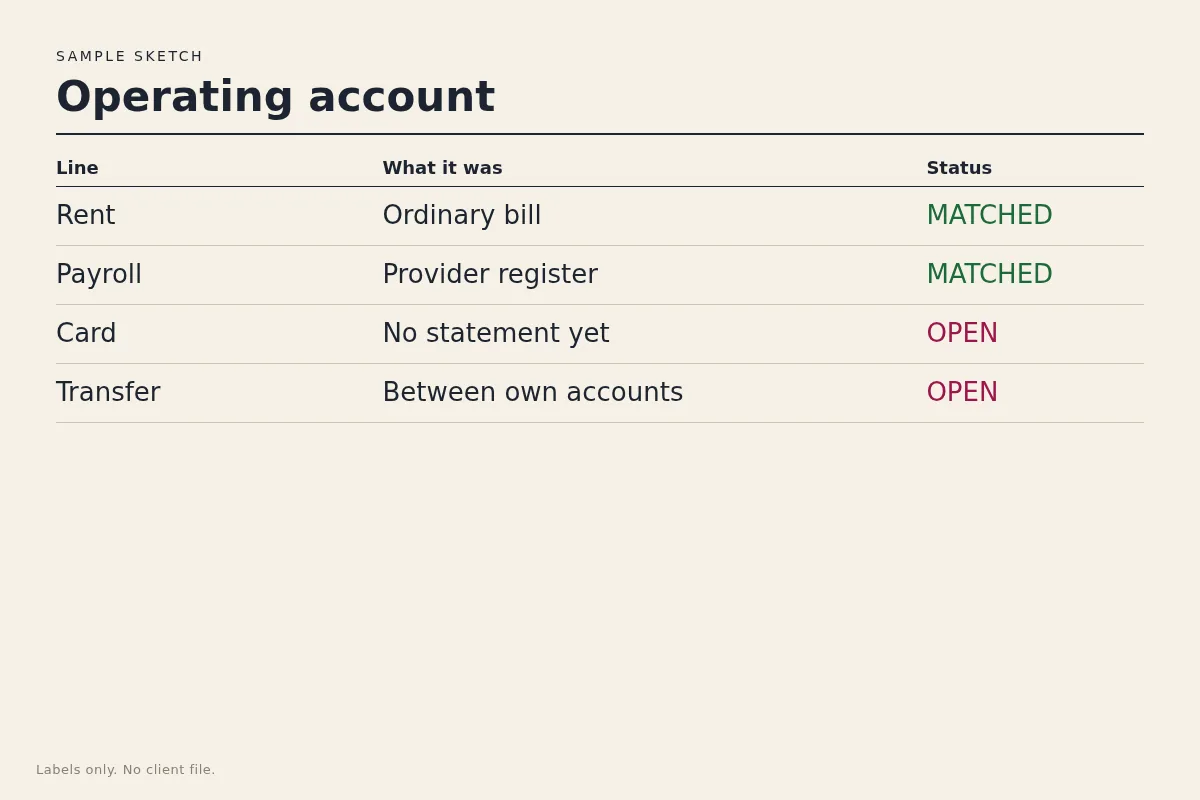
If a statement is missing, that month of that account stays open. We do not build a balance from the feed and call it agreed. You can see which statement we are waiting on.
A worked example, not a client file
Picture three accounts, and only one of them pays the rent.
Read the rest of this part
A worked example, built as a sketch and not from a client file. Picture a shop with three accounts in the feed. One pays the rent and the vendors. One only receives the card deposits. One is a savings account the owner moves money into on Fridays. The first is operating. The deposit account is not, even though the money looks like sales when it lands. The savings movement is a transfer, a pair of lines, not a new sale.
We match the operating account for one month before we touch the other two. The card comes after, because it hides costs the bank will not show until the payment. If the operating month will not tie, we stop and name the missing statement. We do not reconcile all three to look busy.
If this is the month you are in
Name the account that pays the bills, even if you are only mostly sure.
Tell us which month is open
 You will be talking to the Steven Palmieri practice.